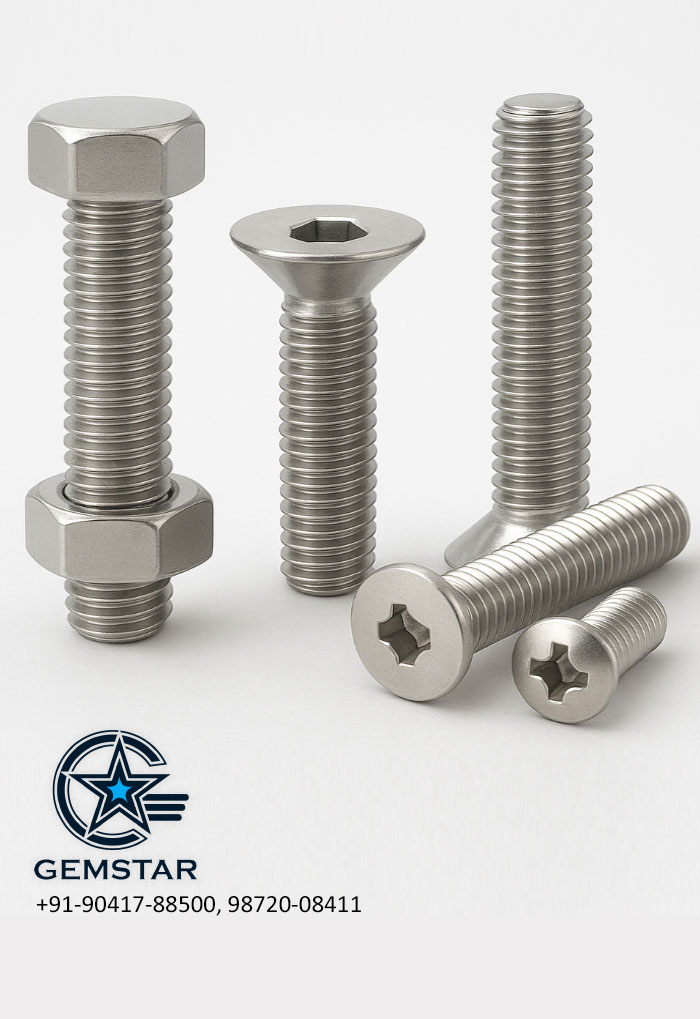


Types of Fasteners Used in Oil and Gas Industry
The oil and gas industry requires high-performance fasteners capable of withstanding extreme conditions such as high pressure, high temperatures, corrosion, and vibration.
In the demanding landscape of the oil and gas industry, fasteners are not merely components; they are critical guardians against the relentless forces of nature and engineering. Hex bolts and hex screws serve as sturdy anchors, designed to withstand colossal pressure while their fully threaded stud bolts provide unmatched tensile strength for high-load applications, ensuring connections remain secure even in the face of severe thermal expansion or contraction. Coupled with a range of nuts whether standard hex, heavy hex for extra robustness, or cap styles that offer added security these fasteners can navigate through an array of challenging environments.
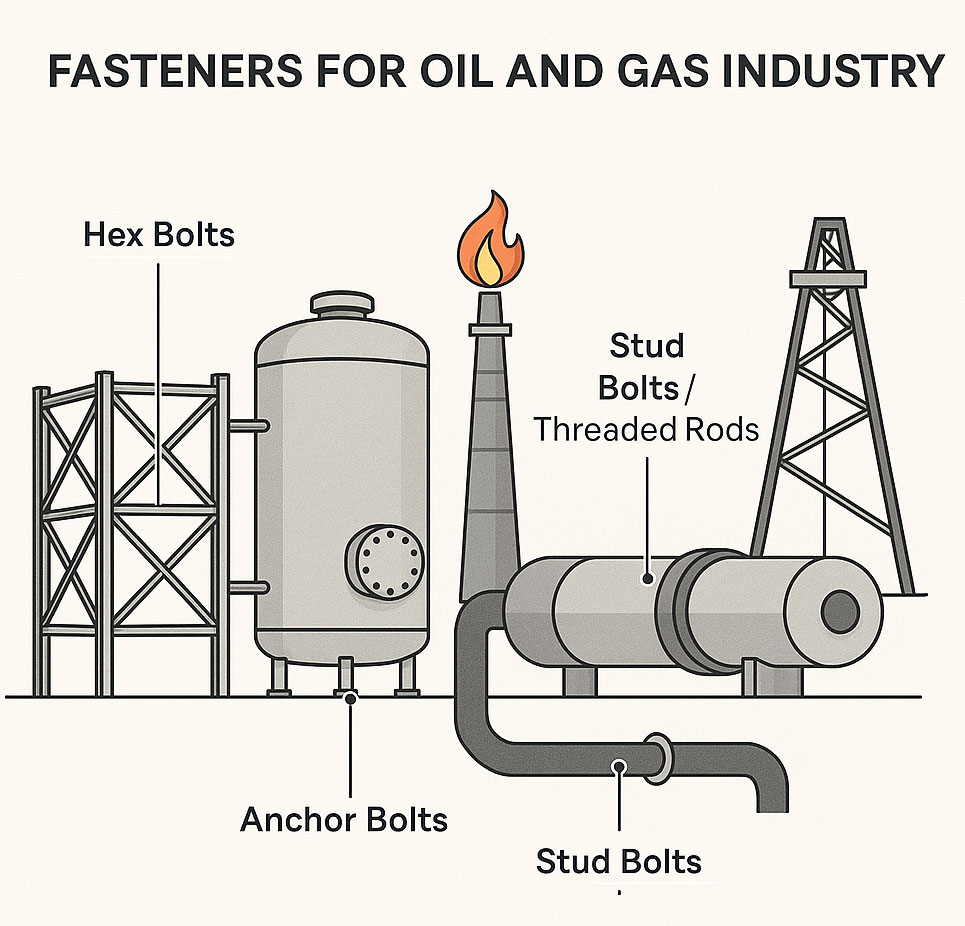
Types of Fasteners Used
| Fastener Type | Description & Application |
| Hex Bolts / Hex Screws | Used in structural connections, flanges, and pipelines where strong clamping is essential |
| Stud Bolts (Fully Threaded) | Common in flange connections (ANSI/ASME B16.5) in both upstream and downstream operations |
| Nuts (Hex, Heavy Hex, Cap) | Paired with bolts/studs; heavy hex nuts preferred for high-strength flange joints |
| Washers (Flat, Spring, Belleville) | Provide load distribution and vibration resistance, especially in rotating equipment. |
| Threaded Rods | Used for long-distance fastening, especially in HVAC or support structures. |
| Socket Head Cap Screws | Used in compact or high-precision assemblies like pump or valve housing. |
| Anchor Bolts / U-Bolts | Secure pipes, platforms, and machinery to foundations or supports. |
Key Challenges in Oil & Gas Fastening
Material Grades Used
| Material / Alloy | Characteristics |
| ASTM A193 B7 / B7M | High tensile strength; commonly used in pressure vessels and valves. |
| ASTM A320 L7 / L7M | Low temperature applications; suitable for cryogenic service. |
| Stainless Steel (304, 316, 316L) | General corrosion resistance; 316L for chloride-rich environments. |
| Duplex / Super Duplex (e.g., S32750) | Excellent resistance to pitting, crevice corrosion and high strength. |
| Inconel, Monel, Hastelloy | For aggressive chemical environments and high temperatures. |
| Zinc/Nickel/Phosphate Coatings | Enhanced corrosion resistance for carbon steel fasteners. |
Applications in Oil & Gas Sector
| Segment | Fastener Applications |
| Upstream (Exploration & Drilling) | Wellhead equipment, blowout preventers (BOP), drilling rigs, mud pumps. |
| Midstream (Transportation & Storage) | Pipelines, compressor stations, storage tanks, metering stations |
| Downstream (Refining & Petrochemicals) | Heat exchangers, pressure vessels, reactors, structural supports |
| Offshore Platforms | Corrosion-resistant fasteners for marine exposure—super duplex, titanium, etc. |
| Subsea Applications | Specialty coatings and exotic alloys (Inconel, Monel, Hastelloy) used. |
Each assembly is further enhanced by flat washers that distribute load evenly across surfaces and spring washers that absorb vibrations from heavy machinery operations, buffering potential loosening effects over time. Meanwhile, socket head cap screws allow for precise torque control during installations in confined spaces where traditional tools may falter. Lastly, when anchoring structures deep within turbulent soil or rock formations, anchor bolts come into play with unparalleled grip and holding power to ensure stability amidst seismic shifts or drilling vibrations. In this realm where stakes are nothing short of monumental, choosing the right combination of these high-performance fasteners is paramount to uphold both safety standards and operational efficiency under extreme conditions.