

- By admin
- 27 Oct 2026
A plain washer is one of the smallest components in any bolted assembly, yet it carries consequences well beyond its size. Specify the wrong grade or dimension, and the joint accumulates problems: the bolt head indents a softer flange, salt air attacks an SS304 washer specified for a coastal structure, or an undersized outer diameter allows pull-through on thin steel sheet. In most cases, the cost to prevent these failures is small compared with what repair and rework demand.
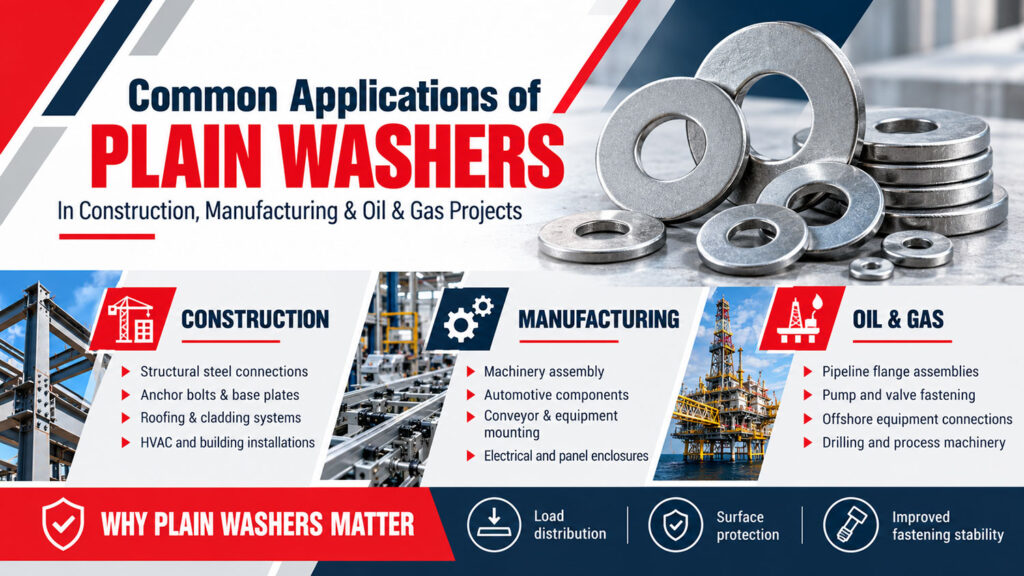
This article is written for engineers and procurement teams working across construction, manufacturing, and oil & gas projects in India. It covers material grades, IS 2016 and DIN 125 standard dimensions, washer type comparisons, and what to look for when sourcing from Indian suppliers. Gem Star manufactures and supplies stainless steel fasteners from India.
The correct flat washer choice comes down to three decisions: the environment it operates in, the substrate it clamps, and the bolt system it supports. Get those three right and the washer is rarely a maintenance concern.
What a plain washer actually does in a bolted joint
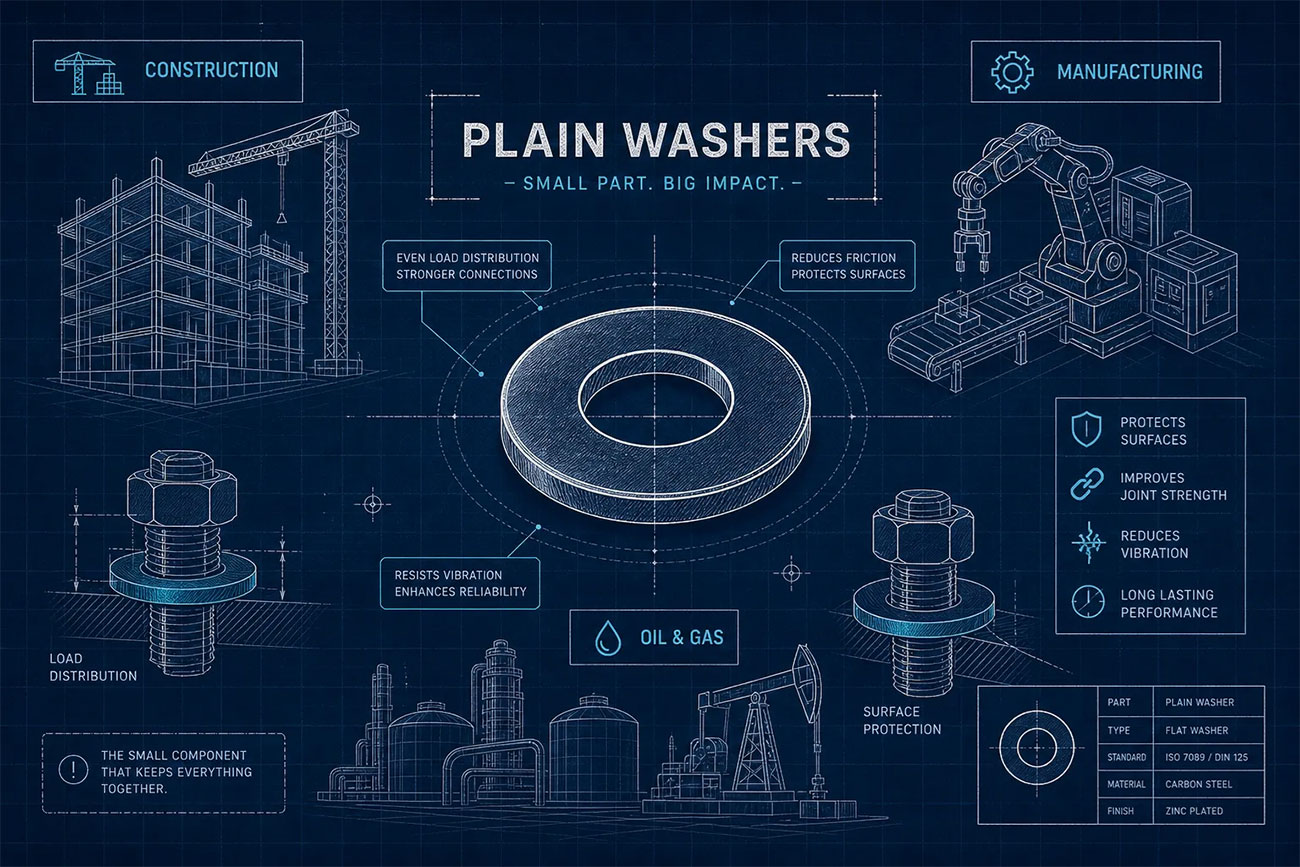
The primary function is load distribution. A plain flat washer increases the bearing area under a bolt head or nut, spreading the clamped load across a wider zone and reducing local contact stress on the mating surface. Without one, a bolt head concentrates force on a small area. On steel plate, that may be acceptable; on aluminium, plastic, composite, or coated surfaces, it causes indentation, scoring, or surface yield that undermines the joint.
This matters most in structural connections, where a controlled preload is the foundation of joint integrity. When the bearing surface embeds or yields, the bolt elongation shortens as the clamped stack compresses, and preload drops. A washer with the correct outer diameter and sufficient hardness prevents that plastic deformation and preserves the original grip length. For high-strength or heavily preloaded joints, the washer itself must be appropriately hard; a soft or undersized washer can cup or yield under load, becoming another source of preload loss.
The second function is surface protection. When tightening, the nut or bolt head rotates against the mating surface.
Without a washer, that rotation scratches coatings, damages anodised finishes, and creates contact points that accelerate corrosion. The washer absorbs that rotational friction and keeps the surface intact. For this reason, washer material must be compatible with both the fastener and the mating surface: mismatched metals in a wet environment create galvanic cells that can sacrifice one component faster than the design accounts for.
Material grades: MS, SS304 and SS316
Mild steel plain washers are the most economical option and genuinely correct for dry indoor environments where corrosion is not a concern. General fabrication, indoor machinery assembly, and structural work in covered buildings are all legitimate applications. What changes the specification is the surface finish: black phosphate for light moisture exposure, electro-zinc plating for moderate humidity, and hot-dip galvanising for outdoor structural assemblies where the entire fastener is exposed to weather.
Choosing MS in the right context is not a compromise; it is sound procurement. Where the environment is controlled, MS saves significant cost across large-volume orders without sacrificing performance.
The stainless decision: SS304 vs SS316
SS304 (A2) is the standard outdoor stainless grade. It handles rainwater, food-contact environments, wash-down areas, and general atmospheric exposure across most of India. SS316 (A4) adds 2–3% molybdenum to the alloy, which significantly improves resistance to chloride pitting, making it the correct specification for coastal structures, marine fittings, chemical plant pipework, and oil & gas assemblies.
Specifying SS304 instead of SS316 in a chloride-rich environment is a commonly reported cause of premature corrosion on projects. The plain washer looks undamaged at handover but can develop surface pitting over months to years, depending on chloride concentration and crevice conditions, gradually weakening the joint contact area. SS316 is not a premium choice in these environments; it is the baseline minimum.
SS202, available from most Indian suppliers, sits between MS and SS304 in corrosion resistance and suits indoor, decorative, or mildly damp applications only. It should not be specified for outdoor, chemical, or high-humidity service where SS304 or SS316 is warranted.
Standard sizes and specifications: IS 2016 and DIN 125
The three dimensions that govern washer selection are inside diameter (ID), outside diameter (OD), and thickness. The ID is intentionally larger than the bolt’s nominal diameter to allow assembly clearance; this must be factored into hole sizing on fabricated components. The table below covers common bolt sizes under both IS 2016 and ISO 7089/DIN 125 Form A. Note the differences: IS 2016 specifies a slightly larger bore for M6 (6.6 mm vs 6.4 mm) and M12 (14.0 mm vs 13.0 mm).
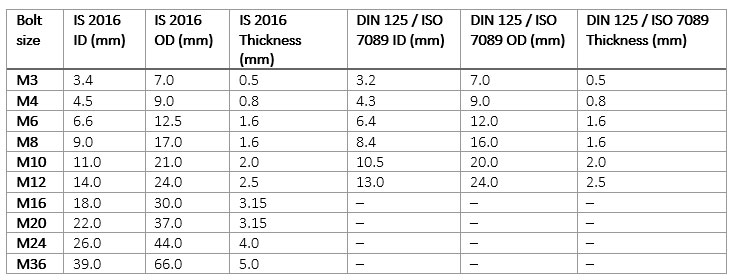
IS 2016 is the governing specification on most Indian construction and infrastructure projects. DIN 125/ISO 7089 dimensions are specified on many export, defence, and internationally procured projects. Where drawings reference both standards, verify the ID before ordering in bulk. The bore differences are small but matter in precision assemblies and for hole-sizing on fabricated steelwork.
Machined versus punched washers: why tolerances matter
IS 5369:1975 governs the tolerances applied under IS 2016 and draws a clear distinction between machined (precision) washers and punched (ordinary) washers. Machined washers hold tighter tolerances on bore, OD, flatness, concentricity, and parallelism. Punched washers carry larger permitted deviations across all those characteristics and are less expensive to produce.
The practical consequence is real: a punched washer in a high-preload structural connection may sit off-centre under the bolt head, create an uneven bearing surface, and distribute load less predictably than the joint design assumes. Specify machined washers for structural and fatigue-critical joints. For general assembly and non-critical applications, punched washers perform adequately and cost considerably less. IS 2016 directs that tolerances on ID, OD, thickness, concentricity, flatness, and parallelism all conform to the applicable class within IS 5369; the exact numerical limits depend on the washer’s nominal size.
Where the plain washer works across sectors
Construction and structural projects
In construction, plain washers appear under anchor bolts, structural bolts, baseplate connections, and roofing fasteners. The function is load distribution: spreading the bolt force over concrete, brick, or steel plate to prevent local crushing. Hot-dip galvanised MS washers are the standard choice for outdoor structural work in India. SS316 flat washers are specified for coastal structures, sewage treatment plants, and any application where the assembly faces persistent moisture or saline air.
IS 2016 is the governing standard on most Indian projects. Procurement teams should verify that supplier documentation confirms the correct grade, finish, and standard before placing bulk orders. A phosphate or plain-finish washer delivered in place of a hot-dip galvanised one looks identical out of the bag; the difference may only become apparent after months or years of exposure, depending on site conditions.
Manufacturing and machinery assembly
In manufacturing environments, dimensional consistency matters as much as corrosion resistance. Flatness and parallelism are critical because uneven bearing under a fastener introduces bending stress into a joint and reduces clamping repeatability across production batches. SS304 washers are standard in food processing and pharmaceutical machinery; zinc-plated MS washers are the norm in general industrial equipment. Gem Star supplies fasteners to manufacturing industries.
Oil & gas and corrosive environments
Oil & gas applications sit at the demanding end of the spectrum: high preloads, process fluids, H₂S exposure, elevated temperatures, and in offshore settings, constant chloride attack. SS316 is the baseline stainless specification for these environments. For splash-zone, submerged, or hot-chloride service, duplex grades or specialised coatings may be required beyond what standard SS316 provides.
The critical engineering point is system compatibility. A plain washer that corrodes faster than the bolt disrupts the joint’s entire preload and establishes a galvanic cell that accelerates deterioration of both components. Specify the washer and the fastener from the same corrosion-resistance category; SS316 washers paired with SS316 bolts in a consistent assembly is the correct approach for offshore and chemical service.
Plain washer vs spring washer: making the right call
A plain washer is the correct choice when the engineering problem is bearing stress, surface damage, or hole bridging. Engineers sometimes reach for a split lock washer by habit, but in a properly preloaded joint, a flat washer with a controlled bearing surface outperforms a spring washer on structural criteria. The split lock washer flattens during tightening, damages coatings with its sharp edges, and does not provide reliable locking in high-vibration service.
High-vibration applications require a validated locking method: a prevailing-torque nut, wedge-lock system, threadlocker, or safety wire. A generic split washer is not a substitute for any of those. For fatigue-critical joints, specify a hardened plain washer (200 HV or 300 HV) rather than relying on washer type to compensate for inadequate preload.
When the substrate is thin sheet, composite, or a soft alloy, use a larger-OD washer to prevent pull-through. The common failure modes from poor selection are worth knowing precisely:
These are not theoretical risks. They are well-recognised failure modes that appear across maintenance and engineering literature in multiple sectors.
What to look for in a reliable supplier
Beyond price, a dependable plain washer supplier in India should confirm the material grade through documentation, provide dimensional conformance to IS 2016 or DIN 125, and carry inventory across the standard size range in both SS304 and SS316. These are not excessive expectations; they are the minimum requirements for any project where the fastener assembly carries structural or process loads.
For bulk construction orders or specialist SS316 supply for a process plant application, get in touch with our team directly.
Conclusion
The decision logic for the plain washer is straight forward once framed correctly. Match the washer material to the environment: MS with an appropriate finish for dry or moderately damp service, SS304 for general outdoor and food-contact applications, and SS316 for coastal, marine, chemical, and oil & gas environments. Use IS 2016 or DIN 125 dimensions for correct sizing, and verify the OD and thickness against the substrate and the preload requirement, not just the bolt diameter.
The washer is one of the cheapest components in any assembly. Specifying the wrong one costs considerably more in rework, corrosion repair, and joint failure than the original price difference between MS and SS316 ever would have, whether the error is in grade, OD, or hardness for the application. Never treat it as an afterthought in the bill of materials.
For technical support on selecting the right plain washer for your project specification, contact the Gem Star team. Whether the requirement is a bulk order for a structural project or a specialist SS316 supply for a process plant, our team will help you source it correctly.