

- By admin
- 30 Aug 2026
For most coastal and above-water marine applications in India, Grade 316 or 316L stainless steel fasteners commonly specified as A4 fasteners are the best general-purpose choice. Their molybdenum content gives them better resistance to chloride-induced pitting than Grade 304/A2. For continuously immersed joints, offshore structures, high mechanical loads, warm or stagnant seawater, and locations where inspection is difficult, Duplex 2205 or Super Duplex 2507** may be the safer engineering choice. Grade 304/A2 should normally be limited to sheltered, low-chloride locations rather than exposed marine service.
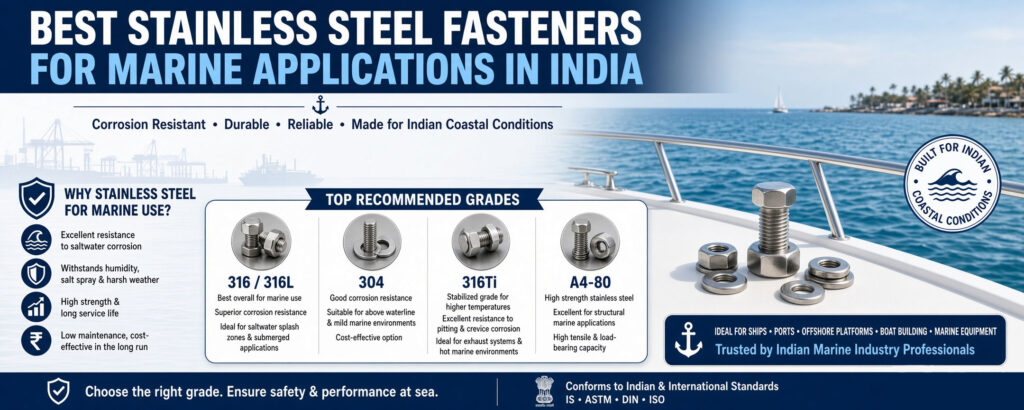
There is no single fastener grade that is ideal for every marine joint. The correct choice depends on salt exposure, water temperature and flow, load, crevices, mating materials, maintenance access, and the required service life.
Quick grade-selection table
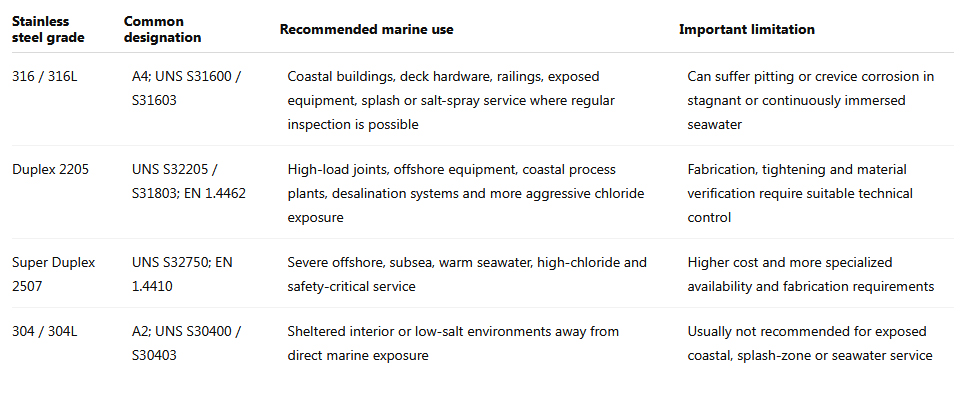
Why are 316 and 316L the usual first choice?
Stainless steel protects itself through a thin chromium-rich passive film. Chloride ions in sea spray and seawater can locally damage that film, leading to pitting and crevice corrosion. Grade 316 contains molybdenum, which improves resistance to this type of chloride attack. Grade 304 does not normally contain the same molybdenum addition and is therefore more vulnerable in salty environments.
This is why 316 is widely known as a marine-grade stainless steel. However, “marine grade” should not be treated as a guarantee that a part is corrosion-proof. The British Stainless Steel Association notes that 316 is widely used in marine applications but remains susceptible to localized attack, particularly pitting and crevice corrosion, when it is in contact with seawater.
Choose **316L** when welding is involved. Its lower carbon content reduces the risk of sensitization and intergranular corrosion associated with welding. The “L” does not make the alloy immune to seawater corrosion; weld heat tint, surface contamination and poorly designed crevices must still be controlled.
For metric fasteners, buyers will often see markings such as **A4-70** and **A4-80**:
A4 identifies the corrosion-resistant, molybdenum-bearing austenitic fastener group commonly associated with 316-type stainless steel.
**70 or 80** is the property class and relates to mechanical strength; it is not a corrosion rating.
An A4-80 bolt may offer higher tensile strength than an A4-70 bolt, but both still require an exposure-specific corrosion assessment.
When should Duplex 2205 be selected?
Duplex 2205 combines an austenitic and ferritic microstructure. Compared with 316L, it generally provides greater strength and improved resistance to chloride pitting, crevice corrosion and chloride stress-corrosion cracking. These properties make Duplex 2205 fasteners valuable for:
Duplex 2205 is not automatically suitable for every seawater joint. Tight crevices, deposits, temperature, chlorination and fabrication quality can still affect performance. The design engineer should specify the exact UNS or EN grade rather than accepting the word “duplex” alone.
When is Super Duplex 2507 justified?
Super Duplex 2507 contains higher levels of chromium, molybdenum and nitrogen than standard duplex grades. It offers greater localized-corrosion resistance and mechanical strength and is commonly considered for extremely corrosive service such as offshore subsea equipment, desalination systems and severe seawater exposure.
It may be appropriate when a joint is:
Because Super Duplex 2507 fasteners cost more and need careful manufacturing and material verification, they should be specified when the service conditions justify them—not simply as a universal upgrade.
Which fastener types work best in marine assemblies?
The head style alone does not determine marine suitability. The grade, strength class, surface condition and joint design matter more. Depending on the equipment, a marine assembly may use:
Bolts, nuts and washers should be specified as a complete system. Using a 316 bolt with a 304 nut or washer can create a weak point in an otherwise suitable assembly. Dimensions, thread tolerances, proof load, preload and locking method must also match the design.
Why Grade 304/A2 is usually not the right choice
Grade 304 performs well in many buildings, factories and clean atmospheric environments. It is also economical and widely available in India. Those advantages can make it tempting for coastal projects, but exposed salt deposits can initiate staining, pitting and crevice attack.
Grade 304/A2 may be considered only where the joint is sheltered from saltwater, regularly cleaned, exposed to very low chloride levels and non-critical. It should not be substituted for 316/A4 merely because both materials are described as “stainless steel.” For exposed coastal structures, boats, docks, port equipment and seawater-processing systems, the initial saving may be outweighed by inspection, replacement and downtime costs.
Marine exposure in India: four conditions to assess
India has a long coastline and a wide range of operating environments—from humid coastal buildings and fishing vessels to ports, desalination plants and offshore energy installations. Buyers should classify the actual exposure before requesting a quotation.
Coastal atmosphere
Fasteners are exposed to airborne salt but not directly to seawater. 316/A4 is commonly the practical minimum for exterior, rain-washed locations. Sheltered areas under canopies can sometimes be more troublesome because salt accumulates without being rinsed away.
Splash and tidal zones
Repeated wetting and drying concentrates chlorides. Crevices under bolt heads, nuts and washers can retain salty moisture. 316 may be usable in controlled, inspectable service, but Duplex 2205 or a higher-alloy grade should be evaluated for critical joints.
Continuous immersion
Oxygen-depleted crevices can prevent the passive film from repairing itself. A blanket specification of 316 should therefore not be assumed safe. Water temperature, velocity, chlorination, biological fouling and joint geometry must be reviewed. Duplex, Super Duplex or another corrosion-resistant alloy may be required.
High-load offshore service
Corrosion resistance and mechanical performance must be considered together. Duplex 2205 and Super Duplex 2507 offer higher strength than conventional austenitic grades, but the final selection must follow the equipment designer’s calculations, applicable code and approved material specification.
What should Indian buyers include in a purchase specification?
A vague order for “marine stainless steel bolts” leaves too much room for interpretation. A strong enquiry or purchase order should include:
Exact alloy
316, 316L, UNS S32205/S31803 or UNS S32750, as applicable.
Fastener designation and property class:
For example A4-70 or A4-80 where the ISO system applies.
Product standard:
Fimensional and mechanical standards for the bolt, screw, stud, nut or washer.
Indian or international compliance:
The Bureau of Indian Standards lists IS 1367 (Part 14/Section 1):2023 as aligned with ISO 3506-1 for corrosion-resistant stainless steel bolts, screws and studs, while Section 2 covers nuts.
Material certificates:
Heat or batch traceability and a material test certificate showing chemical composition and mechanical properties.
Verification requirements:
Positive material identification when grade mix-up could create a safety or corrosion risk.
Surface condition:
Cleaning, passivation and any required corrosion test or acceptance criteria.
Service information:
Chloride concentration, temperature, immersion, loads, mating materials, expected life and inspection interval.
ASTM F593 may be specified for certain inch-series stainless steel bolts, hex cap screws and studs. ASTM A967/A967M covers chemical passivation treatments for stainless steel parts. The project engineer should select the standards relevant to the fastener system rather than combining specifications without checking their scope.
Installation practices that improve service life
Even the correct alloy can fail early if it is installed badly. Good marine-fastener practice includes:
Keeping stainless fasteners away from carbon-steel grinding dust and contaminated tools using smooth, clean surfaces and removing fabrication scale or weld heat tint; avoiding water-trapping crevices wherever the design permits; using a suitable anti-galling lubricant or approved anti-seize compound; tightening at a controlled speed and to a validated procedure; isolating stainless steel from aluminium or carbon steel where galvanic corrosion is a concern; selecting compatible non-metallic washers, sleeves or sealants where required; and washing away salt deposits and inspecting critical joints at planned intervals.
Galling deserves special attention. Austenitic stainless bolt and nut threads can seize during tightening, particularly when they are clean, dry and installed quickly. A lubricant changes the torque-to-preload relationship, so torque values must be established for the actual lubricant and joint—not copied from an unrelated dry-fastener chart.
How to choose a marine-fastener supplier in India
The supplier should be able to do more than provide a verbal grade description. Ask whether the manufacturer can supply the exact material designation, property class, dimensions, certificates, heat traceability, inspection records and surface treatment required by the project.
Gemstar Industries Pvt. Ltd., based in Ludhiana, India, manufactures and exports stainless steel fasteners including bolts, screws, nuts, washers, grub screws, rivets and anchor bolts. Marine buyers can share their drawings, quantities, exposure conditions, load requirements and applicable standards with Gemstar to identify an appropriate fastener specification. Final material approval for safety-critical, offshore or continuously immersed joints should remain with the project’s qualified materials or corrosion engineer.
Frequently Asked Questions
What is the best stainless steel fastener grade for marine applications in India?
Is 316 stainless steel completely rust-proof in seawater?
Is 316L better than 316 for marine fasteners?
What is the difference between A2 and A4 fasteners?
Are A4-80 fasteners more corrosion-resistant than A4-70?
What certificates should be requested for marine fasteners?
Buyers should request a material test certificate with chemical and mechanical results, heat or batch traceability, compliance with the specified ISO, BIS or ASTM standard, and PMI or additional inspection where the project risk justifies it.
Conclusion
For most marine applications in India, **316/316L or A4 stainless steel fasteners provide the best balance of availability, corrosion resistance and cost**. They are a sound general-purpose choice for coastal equipment, railings, deck hardware and many salt-spray environments. They should not, however, be assumed suitable for every submerged or crevice-prone joint.
For high-load, offshore and aggressive seawater service, **Duplex 2205** offers higher strength and better localized-corrosion resistance. For severe, warm, subsea or safety-critical exposure, **Super Duplex 2507** may be warranted. The most reliable specification combines the correct alloy with verified strength, matching nuts and washers, traceable certification, suitable surface treatment, proper installation and an exposure-specific engineering review.