

- By admin
- 03 Aug 2026
In modern mechanical engineering, automotive design, and industrial assembly, fast, reliable, and space-efficient joining solutions are critical. Among the most widely specified fasteners in high-precision applications is the Stainless Steel Allen Socket Head Bolt (commonly referred to as a Socket Head Cap Screw or SHCS). Combining exceptional tensile strength, corrosion resistance, and a compact head footprint, these fasteners are designed to deliver reliable performance under demanding conditions.
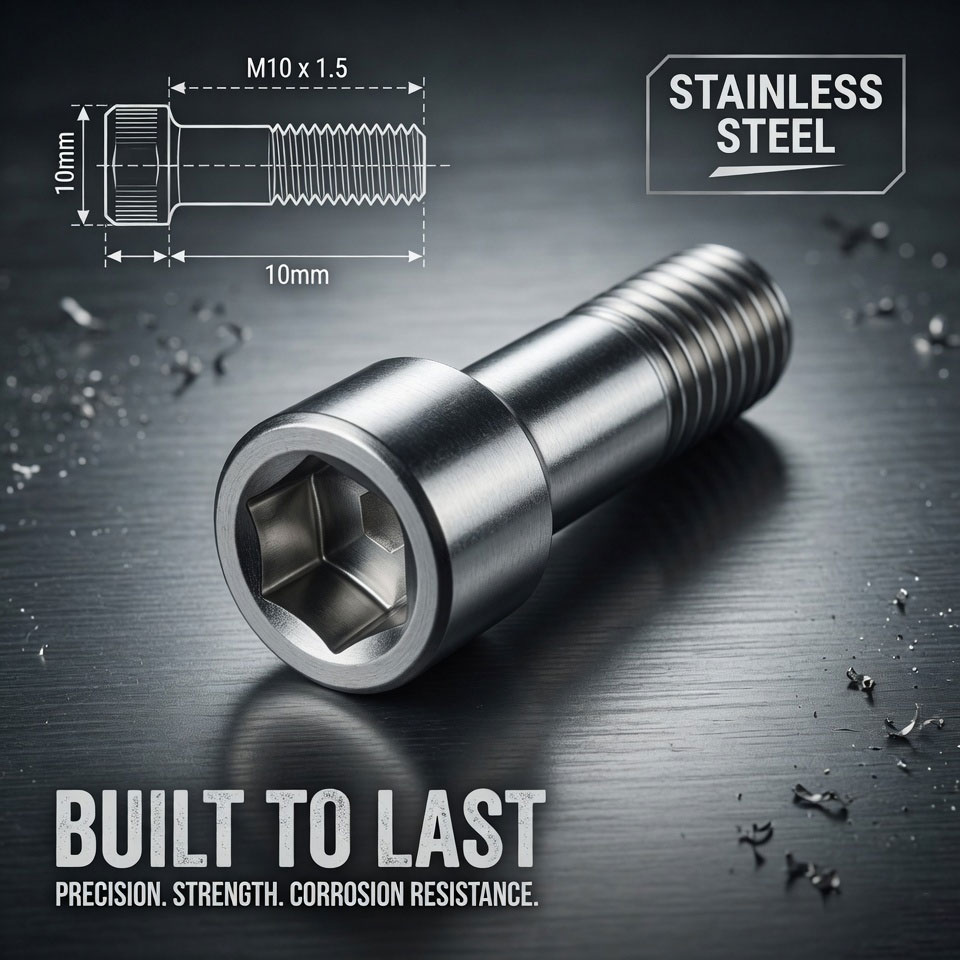
What is a Stainless Steel Allen Socket Head Bolt?
A socket head cap screw features a cylindrical head with a recessed hexagonal (hex) drive socket, tightened using an Allen wrench (hex key) or hex bit. Unlike hex bolts that require external clearance for a wrench, socket head screws are installed inline with the drive axis, making them ideal for applications with limited lateral space or flush-mounted counterbored holes.
Key Anatomical Components
Cylindrical Head: Features knurled or smooth outer walls and a internal hexagonal drive recess.
Unthreaded Shank (Grip Length): Present on partially threaded bolts to offer shear strength across joining surfaces.
Threaded Section: Standardized metric or imperial threads designed to mate with tapped holes or nuts.
Chamfered Point: Eases entry into internal threads during installation.
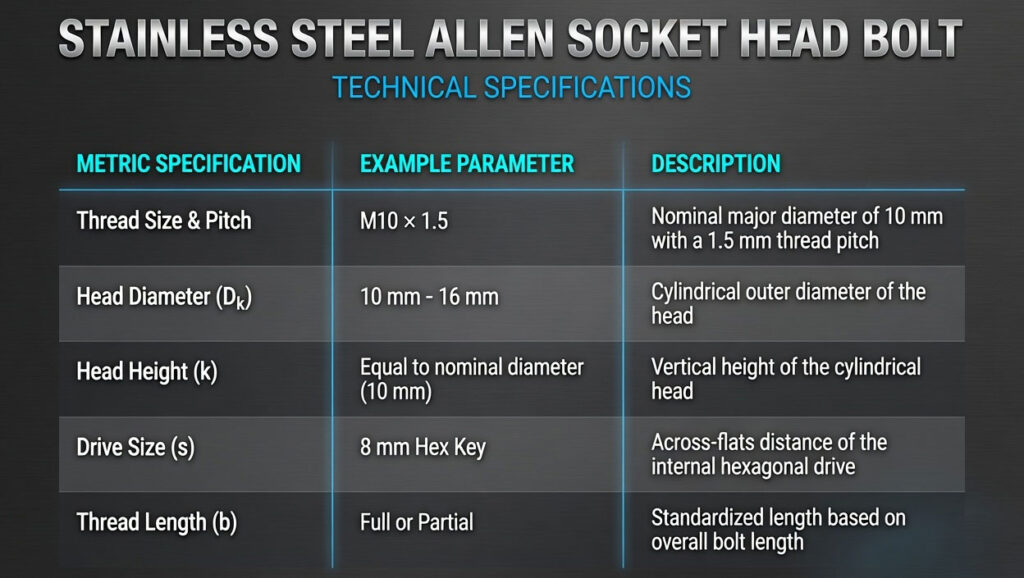
Technical Specifications & Dimensional Blueprint
Based on standard engineering references (such as DIN 912 / ISO 4762), typical socket head bolts follow tight dimensional tolerances:
Material Grades & Corrosion Resistance
Stainless steel socket head bolts derive their corrosion resistance and mechanical properties from chromium and nickel alloys. Selecting the correct grade depends on the operating environment:
A2 Stainless Steel (AISI 304)
Composition: ~18% Chromium, 8% Nickel.
Characteristics: Standard commercial grade offering excellent resistance to atmospheric corrosion, fresh water, and general organic chemicals.
Applications: Indoor machinery, food processing equipment, automotive accessories, and non-marine outdoor structures.
A4 Stainless Steel (AISI 316)
Composition: ~16% Chromium, 10% Nickel, 2–3% Molybdenum.
Characteristics: Enhanced resistance to chlorides, salt spray, acids, and industrial solvents due to the addition of molybdenum.
Applications: Marine hardware, chemical processing plants, offshore platforms, and medical apparatus.
Advantages Over Standard Fasteners
High Clamping Force in Tight Spaces: Internal hex drives eliminate the need for external wrench clearances, enabling installation in recessed pockets or tight assemblies.
Reduced Risk of Cam-Out: The deep hex socket provides full contact surface area for the driver bit, preventing driver slip under high torque loads.
Aesthetic and Flush Finish: Designed to sit inside counterbored holes, resulting in a smooth, snag-free surface.
Superior Corrosion Resistance: Stainless steel alloys resist oxidation, rust, and chemical degradation without requiring additional plating or coatings.
Common Applications Across Industries
Automotive & Motorsport: Engine blocks, intake manifolds, brake components, and custom vehicle builds.
Industrial Automation & Robotics: Precision alignment in linear guides, robotic arms, and CNC machinery.
Electronics & Medical Devices: Non-magnetic assembly requirements in high-precision laboratory tools.
Marine & Aerospace Hardware: Stainless A4 bolts for decks, riggings, and exposure to corrosive environments.
Best Practices for Installation & Maintenance
Use Proper Torque Values: Always torque bolts to manufacturer specifications to avoid stripping internal hex drives or stretching threads.
Apply Anti-Seize Compound: Stainless steel fasteners are prone to galling (friction welding under extreme pressure). Applying a nickel- or copper-based anti-seize lubricant prevents thread seizing during installation.
Select Matched Tooling: Ensure hex keys or driver bits are unworn and fit tightly within the socket to prevent rounding out the internal drive.